The word gets stuck on everything. An ant trail across your kitchen counter. A moth finding a mate half a mile away. A $90 rollerball that promises your dating life will sort itself out. All three get called pheromones, and none of them are lying, exactly. They are just describing very different things wearing the same label. So what are pheromones, really?
So before you decide whether the rollerball is worth it, it helps to know what the word actually means. Not the marketing version. The one biologists have been using since 1959.
Short version: a pheromone is a chemical one animal releases to send a signal to another of the same species. That definition is tight in insects and clear in plenty of mammals. In humans it gets blurry fast, and the blur is exactly where the arguments start.
What are pheromones, exactly?
A chemical message between two members of the same species. One individual releases it, another picks it up, and behaviour or physiology shifts in response. The word comes from the Greek for "carry" and "excite," and it was coined in 1959 by Peter Karlson and Martin Lüscher to name a category that already clearly existed in the animal world.
The key phrase is same species. That is what separates a pheromone from every other smell around you. Coffee is a scent. So is rain on hot pavement. A pheromone is different: a scent aimed by one animal at another of its own kind, carrying information the receiver is built to act on.
The first one ever pinned down was bombykol, the compound a female silk moth releases to pull males toward her. A male moth can track it across remarkable distances at almost unimaginably low concentrations. That is the clean textbook case: a single molecule carrying a single instruction, and a male wired to chase it.
Pheromones aren't hormones
People swap these two words constantly, and they describe opposite directions of travel.
A hormone is an internal messenger. Your body makes it, releases it into your bloodstream, and it tells your own organs what to do. Adrenaline, insulin, testosterone: all hormones, all working inside the one body that produced them.
A pheromone travels the other way, out of the body. It leaves one animal and lands on another. Same rough idea, a chemical carrying instructions, but the audience is external. This matters for the perfume conversation because a lot of product copy quietly muddles the two, implying a spray can flip an internal switch in the person across the room. Nothing sprayed on your neck is dosing anyone else's bloodstream.
What are the main types of pheromones?
Biologists group them less by what they are made of and more by what they do. Four rough categories cover most of it:
| Type | What it does | Animal example |
|---|---|---|
| Releaser | Triggers a fast, more or less immediate behaviour | A moth flying toward a mate |
| Primer | Causes a slow physiological change over time | Queen bee scent suppressing worker reproduction |
| Signaler | Communicates information, like identity or status | Scent that marks an individual or territory |
| Modulator | Subtly shifts mood or emotional state | The category most human claims fall into |
The lines are fuzzy and a single compound can wear more than one hat. But the split is useful for the human question. The loud attraction claims usually imply releaser behaviour, the do-something-get-a-reaction kind, while the more defensible human research sits down in modulator territory, where the effects are quiet and gradual and easy to miss.
Do humans even have pheromones?
Here is where the tidy insect story falls apart. Humans clearly produce scented compounds, especially from the apocrine glands packed into the armpits and groin. Newborns orient toward their mother's scent. Something is going on. Whether any of it counts as a true pheromone in the strict sense is still being argued in the literature.
The sticking point is detection. In many animals, pheromones get read by a dedicated bit of anatomy called the vomeronasal organ, tucked in the nose and wired straight to the brain's emotional circuitry. Humans have a structure in roughly the right place. Whether it still functions in adults, or is just a leftover from development, is genuinely contested. No agreed-on detector means no clean mechanism to point at, which is why careful writers avoid lines like "activates your VNO to trigger attraction." The science does not support the certainty in that sentence.
This is a different question from whether pheromone products do anything, and the two get tangled all the time. If you came here trying to decide whether a spray works rather than what the word means, that is its own long argument, and I laid it out in the guide on whether pheromones actually work.
Which compounds count as human pheromones?
When a perfume says "human pheromones," it is almost always leaning on a short list of molecules, the same names the enthusiast community has been testing and arguing over for years. Six come up again and again:
Notice what is not on that list. Oxytocin, dopamine, and phenethylamine all show up in product ingredient panels, and none of them are pheromones. Community researchers flag their presence as a marketing red flag rather than a feature. A real formula names real compounds. If a label hides behind the phrase "human pheromones" with nothing underneath it, the vagueness is the tell.
I keep the deeper reads on the two most-tested compounds separate, because each has its own body of evidence worth sitting with: the androstadienone guide covers the male-targeting molecule with the best published data, and the androstenone guide covers the potent one the community treats with the most caution.
- → Androstadienone. Found in male sweat, sometimes called the "love molecule." It carries the cleanest published data of the six, mostly around mood and comfort rather than attraction.
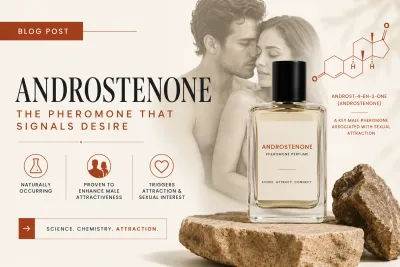
- → Androstenone. The most discussed and the most warned about. Community reports tie it to a dominant, masculine read, and it is very easy to overapply.
- → Androstenol. Associated with warmth, approachability, and social charisma.
- → Androsterone. A milder male-axis compound tied to status and a sense of maturity or trustworthiness.
- → Copulins. Female-coded compounds with a small evidence base around a short male testosterone response.
- → Estratetraenol. Another female-axis molecule, studied for a subtle effect on how men rate mood.
Pheromones in the rest of the animal world
It is worth remembering how well this works outside of us, because the contrast is the whole point. Ants lay pheromone trails so precise that a colony can route hundreds of workers to food and back without a single one getting lost. Moths, as mentioned, track mates across open air on a few molecules. Pigs respond to androstenone so reliably that a synthetic version is sprayed on sows in breeding programs.
In those cases nobody argues about whether the effect is real. The signal goes out, the behaviour follows, and you can measure it in a barn. The human version of the story is quieter and messier, and that gap is exactly why the category attracts both genuine researchers and people selling switches that do not exist.
So what are pheromones doing in your perfume?
The honest framing is narrower than the ads. A pheromone perfume is a fragrance built around one or more of those candidate human compounds, usually in a scented or unscented base. The good ones name what is inside and keep their claims sane. The rest borrow the word "pheromone" for the association and hope you do not ask which molecules, at what dose.
Knowing the definition is your filter. Once you understand that a pheromone is a specific named compound with a specific small body of evidence, "contains powerful pheromones" stops sounding impressive and starts sounding empty. You want the label that names androstadienone or androstenol and tells you roughly how much, not the one selling a feeling.
If you want to see that filter applied to actual products, the lists for pheromones for men and pheromones for women run the same rubric over every entry, and the guide to spotting a real pheromone cologne walks through the disclosure and concentration signals that separate an honest formula from a hopeful one.
The honest bottom line
A pheromone is a chemical signal between members of the same species. In insects and many mammals that is a clean, measurable fact. In humans it is a live scientific question, resting on a short list of candidate compounds and a detection pathway nobody has fully settled.
That uncertainty is not a reason to write the whole category off, and it is not permission to believe the loud claims either. It just means the useful move is to treat the word precisely. Ask which compounds. Ask how much. A product that answers both has earned a fair look. One that only offers the word, and the feeling attached to it, has told you most of what you need to know.