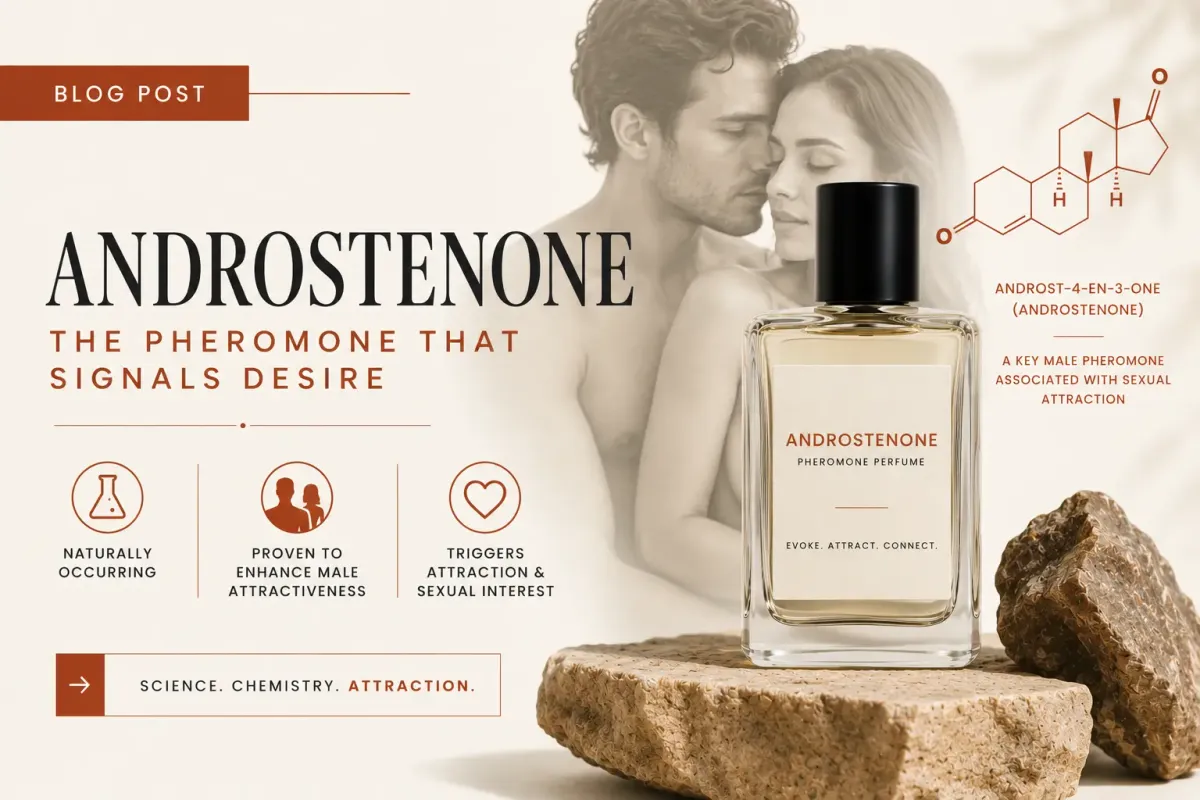
Androstenone is the compound most affiliate sites reach for when they want to promise dominance in a bottle. The pheromone community warns about it first, for a simpler reason: it's the one most likely to backfire.
This guide gets into what androstenone actually is, what the handful of controlled studies on it found, and why the community's core warning, "androstenone has teeth," holds up against both the science and the field reports.
What is androstenone?
Androstenone (5α-androst-16-en-3-one) is a steroid your body produces from testosterone and releases through the apocrine glands in the armpits and groin. It's odorless when it leaves the skin. Bacteria on the skin's surface convert it into the musky, sweat-like compound that some people can smell and a large minority can't smell at all.
The pheromone community treats it as the backbone compound of male sexual signaling, the counterpart to androstadienone's emotional-warmth role and androstenol's approachability role. Per a review of human pheromone research, androstenone and androstenol are both metabolites of the same 16-androstene pathway. Concentrations of both run significantly higher in men.
What does the science actually say about androstenone?
The strongest controlled study on androstenone found it lowered attractiveness ratings instead of raising them. Sit with that before reading any marketing copy that names this compound.
In a study reviewed by Grammer and colleagues, Filsinger and colleagues had participants rate vignettes of a fictional male and female target while exposed to androstenone, androstenol, a synthetic musk, or no odor. Females exposed to androstenone rated the male target as less sexually attractive. Males exposed to androstenol, a different compound, rated the same male target as more attractive. These molecules aren't interchangeable, and they don't point the same direction.
Other work in the same review found physiological effects that fall short of an attraction claim. Van Toller and colleagues measured higher skin conductance, a marker of physiological arousal or alertness, in people exposed to androstenone versus unexposed controls. Grammer's own work found that women rate androstenone differently depending on where they are in their menstrual cycle, and that oral contraceptive use changes the perception too. So there's a real, measurable response, just not a clean "more attractive" signal running in one direction.
A separate line of research looked at who can smell androstenone at all. A meaningful share of people are anosmic to it, or need much higher concentrations to pick it up. Pierce and colleagues found that people who can smell androstenone report a negative effect on their interpersonal relationships from odors more often than people who can't smell it at all. That's not a study about attraction. It's a study suggesting the people most sensitive to this one compound also notice fastest when a smell goes wrong.
None of this makes androstenone useless, but it does make the marketing dishonest about what the lab evidence actually shows, and closer to the community's own caution than to the sales copy.
Why does the community say "androstenone has teeth"?
Because dose determines whether androstenone reads as commanding or off-putting, and the margin between the two is narrow. This is the single most repeated warning in community hit reports on this compound.
At low doses, wearers and observers describe a masculine, sexually present, higher-status feel. Some men report that other men get subtly tense or competitive around them, which the community reads as a status signal landing. Turn the dose up and the same compound reads as harsh, dirty, or aggressive. People put up walls instead of leaning in.
Overuse punishes androstenone faster than it does most compounds in this category. That's the reason it's rarely handed to someone as a first bottle.
Context matters: where androstenone performs, and where it backfires
Nightlife, a one-on-one date, a small group where you already have the room's attention: those are the settings where the community reports the clearest positive read on androstenone, since dominance and sexual presence are already the goal there.
Job interviews and boardrooms are a different story. Big groups you don't control read an aggressive or intimidating signal as a liability, and most wearers can't tell it's happening until the room already feels off. If the goal is broad social ease instead of sexual signaling, androstenol is the safer compound to reach for. The pheromones that attract women breakdown covers how the different molecules split that work.
The smell: why androstenone reads as musky and animal
Androstenone smells musky, sweaty, sometimes distinctly animal to people who can pick it up at all. That's because it isn't unique to humans. It's one of the two primary compounds, alongside skatole, behind boar taint, the odor issue that shows up in pork from male pigs. That's where the community's "boar-like" description comes from. It's a chemical fact, not an insult.
Almost no product wears androstenone unmasked because of this. A cover scent (leather, tobacco, dark musk, and vetiver are the usual picks) softens the raw compound's edge while keeping the effect underneath it.
Which products actually disclose androstenone?
Very few, and that scarcity is itself worth reporting. Only a small number of labels in the catalog name androstenone directly with a dose attached, which puts the burden on you to ask before assuming any "pheromone blend" actually contains it.
Love Scent's New Pheromone Additive for Men (7.3/10) is the clean exception. Its label states 3 mg total pheromone content per 10 ml bottle: 1 mg androstenone, 1 mg androstenol, 1 mg androstadienone. Exact molecules, exact milligrams. That level of disclosure is rare enough to call out by name.
Royal Pheromones' Sample Fragrance Pack (6.9/10) is the only other product in the catalog tagged with androstenone at all, and even there it shows up in the scent-note field rather than a stated dose. The gap isn't a quirk of one brand. It runs across the whole catalog.
Most other labels don't get close. They list generic cosmetic ingredients (alcohol, fragrance, carrier oils) with the pheromone blend buried behind the word "fragrance," or they name androstenone's cousins, androstenol and estratetraenol, without naming androstenone itself. Community consensus on Pherotruth and r/pheromones identifies several Liquid Alchemy Labs formulas, including Bad Wolf and Voodoo for Men, as androstenone-forward, based on field testing rather than the label copy. The product page itself still just says "proprietary pheromone blend."
Treat a bare "pheromone blend" listing as neutral, not as proof of androstenone. If a brand won't name the compound, assume you don't know what you're wearing until you test it yourself.
How should you use androstenone without overdoing it?
Start with one spray on warm skin, in whatever setting you actually want the dominant read to land. The gap between "commanding" and "aggressive" is just concentration, so treat the first application as calibration, not a full dose.
Give it time before reapplying. The compound, and the cover scent built around it, needs time to develop. Adding more before you've read how the first application is landing is the most common way wearers tip into the "too much" zone the community keeps warning about. The how to apply pheromones guide covers dosing mechanics in more depth for any compound in this category, not just this one.
Match the setting to the compound. Save androstenone-forward products for evenings, dates, and settings where a strong presence is the goal. Reach for something milder, androstenol, or a light androstadienone blend, on daytime or professional days.
Bottom line
Androstenone carries more community folklore than any other compound in this category, and the least straightforward lab support to match it. The strongest available study found it lowered attractiveness ratings instead of raising them. The more consistent finding across the research is a physiological response, skin conductance, negative odor sensitivity, rather than a proven attraction effect.
That's not a reason to skip it. Treat the community's caution as the actual operating manual: low dose, matched context, a cover scent doing real work. Disclosure is thin across the catalog, so a labeled, dosed product like New Pheromone Additive for Men is a more honest place to start than a blend that only promises "pheromones" on the front of the bottle. For the scored, disclosed formulas in this category, the men's ranked list is where to compare them.