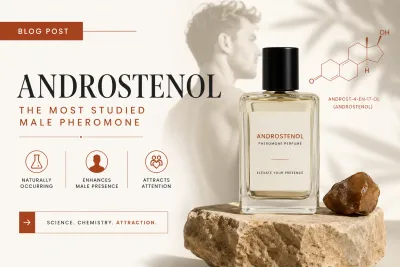
Androstenol gets sold as the friendly one. The icebreaker. The social pheromones category exists almost entirely on the promise that one compound makes you warmer and more approachable in a room full of colleagues.
There is exactly one study that tested whether it changes what people actually do, rather than what they say on a questionnaire. In that study, men avoided the space it was applied to. Use dropped from 37.5% to 8%.
What did the one behavioral study actually find?
Avoidance, not approach. In 1987, Gustavson, Dawson and Bonett ran a five-week experiment in the Journal of Comparative Psychology, double-blind throughout, and it remains the clearest test of whether androstenol changes human behavior rather than self-reported mood.
The setup was deliberately mundane. Two architecturally identical dormitory restrooms, one men's and one women's, each with four stalls. Observers recorded which stall people picked when all four were free, across 480 recorded uses. Two of the four stalls were treated with androstenol during week two, and with androsterone as a control during week four. Weeks one, three and five were untreated baselines. Neither the subjects nor the observers knew which stalls were treated, and the compounds were applied to small Plexiglas squares on the stall doors so nothing about the rooms looked different.
| Week | Men's use of treated stalls | Women's use |
|---|---|---|
| 1 (baseline) | 37.5% | 40% |
| 2 (androstenol) | 8% | 42% |
| 3 (baseline) | 40% | 44% |
| 4 (androsterone) | 44% | 32% |
| 5 (baseline) | 38% | 30% |
Men's use of the treated stalls collapsed during the androstenol week and snapped back the moment it was removed. The androsterone control changed nothing, which rules out "any musky steroid smell would do it." Women were unaffected across the board.
Why the avoidance result matters more than it looks
Because it is the opposite of what the product copy promises, and it comes from the strongest study design in the whole compound. Most androstenol research measures how people rate photographs or report their own mood. This one measured a choice people made with their feet, without knowing they were in an experiment.
The researchers' interpretation was that androstenol acts as a spacing signal: something closer to "this area is occupied" than "this person seems nice." That reading fits the animal literature, where scent marking regulates how close others get rather than making the marker more likable.
One honest caveat, which the authors raised themselves rather than burying. The amount applied to those stalls was far greater than what human sweat actually secretes, and they wrote plainly that nobody has shown lower concentrations doing the same thing. A product dosed at realistic levels isn't obviously the same thing as a Plexiglas square loaded with 2.5 mg of the stuff.
The asymmetry nobody selling these mentions
At work, the upside and the downside aren't the same size. Working well, a social pheromone buys you a conversation that flows a little easier and a room that feels marginally warmer. You'll barely register it happening. The failure case differs in kind: a colleague who remembers you as the person whose cologne made a closed meeting room unpleasant, and who mentions it to someone else.
That gap is the argument for restraint at the office, and it holds regardless of which study you believe. You're trading a benefit you probably won't notice against a cost that attaches to your name.
It also rules out an entire category of product. Androstenone-forward blends are built to project dominance and sexual presence, which is the wrong signal in almost any workplace and actively counterproductive in an interview. The catalog's androstenone guide covers why the compound reads as aggressive at higher doses. Save those for evenings.
Which products suit a professional setting?
Unscented and androstenol-forward, in that order of importance. Discretion matters more than compound choice at work, because a fragrance nobody can place is a fragrance nobody complains about.
Liquid Alchemy Labs' HYPNOTICA Social (7.3/10) is the clearest fit in the catalog. It's an unscented, androstenol-forward blend, and the site's own verdict describes it as built for rooms where Bad Wolf or Voodoo would be a mistake. That is precisely the distinction this article is about.
Love Scent's New Pheromone Additive (7.3/10) is the other sensible pick, mostly because it tells you exactly what you are wearing: 1 mg androstenone, 1 mg androstenol, 1 mg androstadienone per 10 ml. Knowing the dose matters more in a professional setting than anywhere else, since the whole game is staying under the threshold where anyone notices.
There are 48 unscented products in the catalog, collected on the unscented list, and unscented is the safer default for the office for a reason that has nothing to do with pheromones. Shared air is the constraint. Plenty of workplaces have fragrance-sensitive colleagues or outright policies, and an unscented base sidesteps the argument entirely.
Bottom line
The social pheromones pitch rests on androstenol, and androstenol's one behavioral study found men avoiding the treated space instead of gravitating toward it. The result survived a control compound and a double-blind design, and it pointed the opposite way from what the category sells. It also used a dose far above anything a human body produces, which the authors said plainly.
Try the compound if you want. The promise attached to it is the part that doesn't survive contact with the evidence. If you wear it to work, pick something unscented and disclosed, dose it lower than you want to, and judge it on whether anyone reacts rather than on how it makes you feel. The unscented list is where the discreet options are scored.