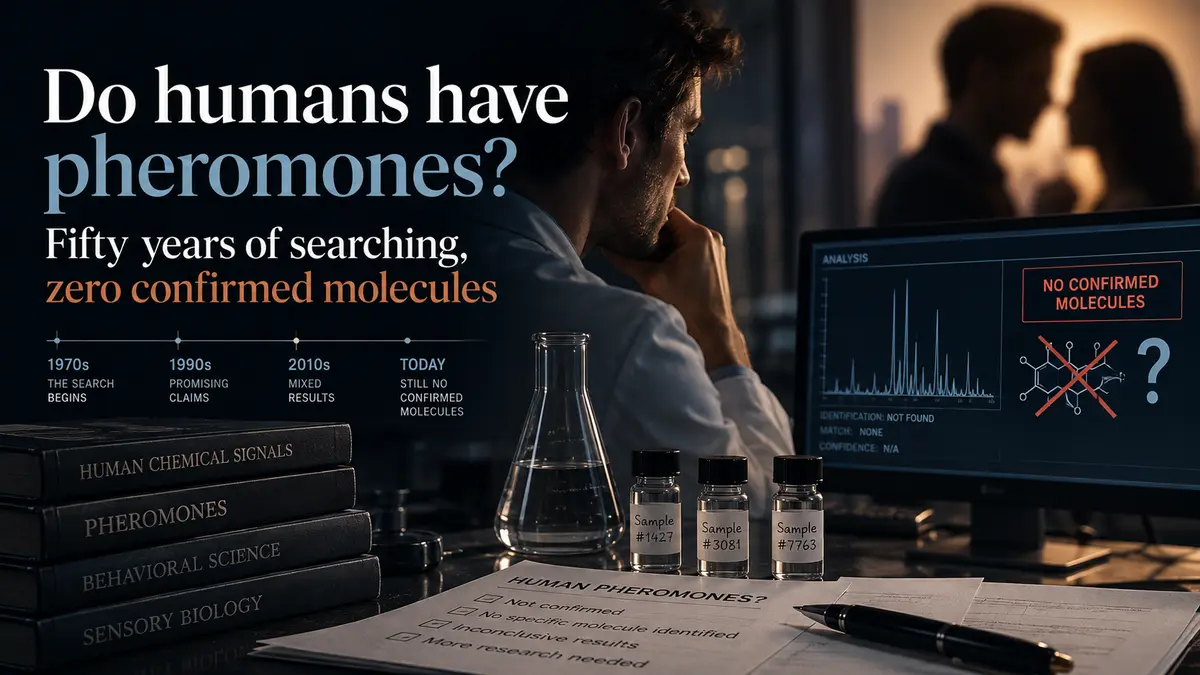
Biologists have confirmed pheromones in the silkmoth, the rabbit, and the Asian elephant. Ask whether humans have pheromones and the answer gets less comfortable fast: no molecule has ever cleared the same bar in our species. Not one, and not for lack of people looking.
That reads like a debunking. It is not one. The gap between "no confirmed pheromone" and "none of this does anything" is wide, and almost every article you will find collapses it in one direction or the other.
Do humans have pheromones?
No confirmed human pheromone exists. Zero molecules have been isolated, tested, and independently replicated the way biologists do it for other species.
Tristram Wyatt, a zoologist at Oxford, put the state of the field bluntly in a 2015 review in Proceedings of the Royal Society B. His verdict on the famous four: there is no reliable bioassay-led evidence that androstenone, androstenol, androstadienone or estratetraenol are human pheromones. He called the preceding period the lost decades.
The problems he catalogued are the ordinary ones. Small samples. Effect sizes that shrink on retesting. Positive publication bias. Almost no replication.
None of that proves humans lack pheromones. It means the question is open, and has stayed open while the category built a market on top of it.
What would it take to prove humans have pheromones?
A working bioassay, which means starting from a behavior and hunting backward to the molecule. That method has worked before, and the cleanest example involves rabbits.
In 2003 Benoist Schaal and colleagues published a rabbit pheromone in Nature. Newborn rabbits perform a stereotyped nipple-search when they smell something in their mother's milk. Schaal's team collected the volatiles, ran them past actual newborns, and found one compound that triggered the search: 2-methylbut-2-enal.
Isolated molecule. Reproducible response. Independent replication. That is what a confirmed mammalian pheromone looks like.
Human research mostly ran the opposite way. Researchers started with molecules already isolated from pigs and sweat, then went looking for effects. Androstenone is a genuine boar pheromone, which is how it entered this conversation at all. Nobody established a distinctly human behavior first and worked back to its chemical trigger.
Why did the four famous molecules fail?
Because the effects kept disappearing when the studies got bigger and better controlled. The pattern repeats across two decades.
Androstadienone and estratetraenol are the two with the most commercial mileage, usually described as male and female signaling molecules. In 2017 a team at the University of Western Australia ran a double-blind test on both. Across 46 participants judging gender and 94 rating faces for attractiveness, exposure changed nothing measurable.
The follow-up is more damning, because it was pre-registered. A 2024 study in Royal Society Open Science tested whether androstadienone shifted prosocial behavior and reported little evidence that it did.
Pre-registration matters here. It locks the hypothesis and the analysis before data collection, which removes most of the room where small positive findings used to appear. When that room closed, so did the effect.
This is worth holding alongside the compound guides on this site. Our androstenone guide describes what wearers consistently report. That reporting is real. It is a different category of evidence from a controlled trial, and the honest move is to keep the two labeled.
Does the vomeronasal organ work in adults?
The structure is there in many people. The wiring is not. Michael Meredith reviewed the strongest and weakest evidence for human vomeronasal function in Chemical Senses back in 2001 and found no persuasive case for functional signaling.
The anatomy tells the story. Most adults have a small pit in the nasal septum where the organ sits in other mammals. What appears absent is the rest of the apparatus: the sensory neurons, the accessory olfactory bulb, the nerve connection carrying signals to the brain. Human embryos develop the structure. It regresses.
A 2023 review in Surgical and Radiologic Anatomy revisited the clinical significance and reached a similar place, treating the adult organ as a vestigial remnant rather than a working sense.
So when a label implies a product reaches you through this route, the anatomy does not support the mechanism. If these compounds do anything in humans, they are almost certainly going through ordinary smell.
Whatever happened to menstrual synchrony?
It has not held up, and it was the single most cited piece of evidence for human pheromones for thirty years. Martha McClintock reported in 1971 that women living together drifted toward aligned cycles.
The finding was compelling and it spread everywhere. Then people checked. Yang and Schank tracked 186 women in Chinese dormitories over more than a year and found cycles diverged as often as they converged, which is what chance produces given normal cycle variability.
Later reviews landed in the same place. Two cycles of different lengths will overlap periodically whether or not anything is passing between the people involved, and the original analysis had counted those overlaps as signal.
Losing McClintock cost the field its most famous data point. What remains is the harder, less quotable work.
Humans send chemical signals either way
Here is where the flat dismissal breaks down. Human chemosignaling has produced results that survived scrutiny, and the best of them came from tears.
Noam Sobel's group at the Weizmann Institute published in Science in 2011 that men who sniffed women's emotional tears showed reduced self-reported arousal, reduced physiological arousal, and measurably lower testosterone. Brain imaging backed it up. The tears themselves were odorless to the men sniffing them.
That is a genuine chemical signal, passing between people, changing a hormone. It is also not a pheromone in the strict sense, because no one has isolated the responsible molecule.
The distinction sounds pedantic and is not. "Chemosignal" says something in body odor affects other people. "Pheromone" says a specific identified molecule reliably produces a specific response across the species. Only the first has support.
Are pheromones FDA approved?
No pheromone perfume has been approved by the FDA for any behavioral or therapeutic claim, and none needs to be. These products are sold as cosmetics in the US and EU, not as drugs or supplements.
That classification does the quiet work here. A cosmetic carries no requirement to demonstrate that it does what the box implies. There is no trial to run, no efficacy threshold to clear, no regulator checking whether the molecule inside produces the effect on the label.
The limits sit elsewhere. Claims cannot cross into drug territory, so a brand promising to treat or cure something invites a different kind of attention. The FTC can act against advertising it judges deceptive or unsubstantiated. Neither mechanism requires anyone to prove a pheromone works before it ships.
Which explains the durability of the gap. A brand can print "human pheromones" on a bottle indefinitely without ever meeting the standard described above, because no rule ties the word on the label to the evidence in the literature.
What this means for the bottle on your shelf
The compounds in these products are real molecules at real concentrations. What is unearned is the word attached to them.
A brand naming androstadienone at a stated concentration is telling you something true and checkable. That is why compound disclosure carries weight in the Phero Score across all 299 products in the catalog, and why brands listing "human pheromones" with no molecule named score worse. Disclosure is an honesty signal. It is not proof the molecule does what the label implies.
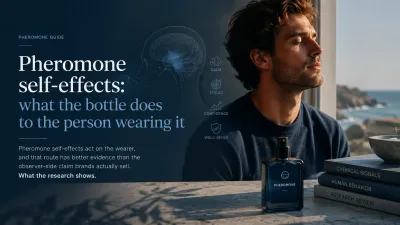
The better-grounded claim is the one brands rarely advertise. Self-effects, meaning what the wearer notices in themselves, have sturdier support than anything about how other people respond. If you are buying, that is the more realistic expectation to hold.
Community field reports are worth reading, with their limits in view. Thousands of Pherotruth and r/pheromones posts are not a controlled trial, and nobody in them is blinded. They are still the largest body of real-world observation this category has, which is why we weigh them and label them as what they are.
Where that leaves the category
The scientific answer has not moved in a decade: unresolved, with the specific molecules being sold looking weaker each time somebody tests them properly.
The commercial answer is separate. People buy these products, wear them, and report things. Some of those reports are expectancy. Some may not be. Nobody has run the study that would separate the two on these formulas, and no brand is funding it.
If you want the chemistry without the marketing layer, start with what pheromones are and then read whether they work in practice. Both posts stay inside what the evidence supports, which is a smaller box than the labels suggest.