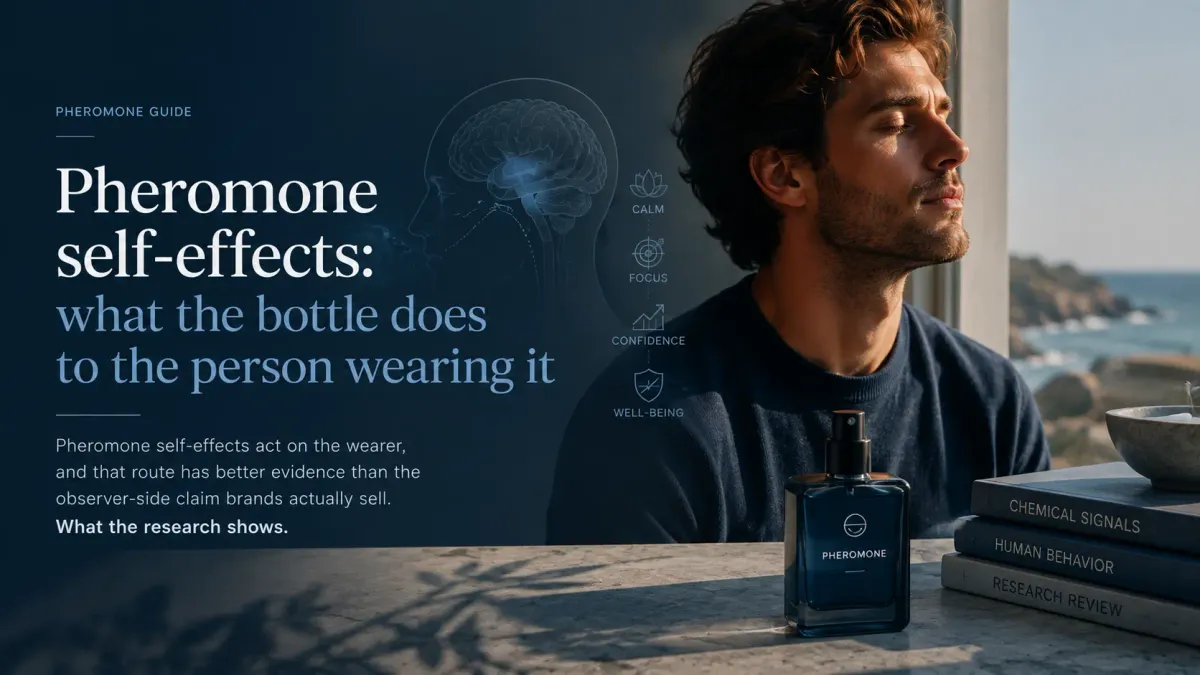
Every product page sells the same promise: other people will respond to you differently. That claim keeps failing when someone tests it properly. The wearer-side claim, the one treated as a side note on forums, has held up better.
This is the honest version of the confidence question, including the part where the effect turns on you.
What are pheromone self-effects?
They are what you feel wearing the product, before anyone else has reacted to anything. The community named them, not the brands, which is itself informative.
The reports cluster by compound. Androstenone gets tied to confidence and aggression in the wearer, energizing for some people and agitating for others depending on temperament and context. Androstenol reads softer, more social ease than dominance. Androstadienone sits closer to mood than to presence.
Read enough field reports and the descriptions get physical. One widely quoted account of Bad Wolf lists a deeper tone of voice, bigger but more deliberate body language, and more direct communication, all of it happening without the wearer consciously deciding to do any of it.
That is a specific claim, and a testable one. It says the product changed behavior, not perception.
Are pheromone self-effects just placebo?
In your own experience, you cannot tell, and neither can anyone else without a blind test nobody has run on these products. You know what you sprayed. You bought it hoping for something.
Here is where most write-ups stop, usually with a shrug about placebo. That is the wrong place to stop, because the interesting question is not whether belief is involved. Belief is obviously involved. The question is whether the loop produces anything real once it starts.
Enclothed cognition is the cleanest parallel. Adam and Galinsky put students in a lab coat and their errors on a Stroop task dropped by half, but only when the coat was described as a doctor's coat rather than a painter's. Same garment. The meaning did the work, and the measured improvement was still an improvement.
Nobody calls that fake. It is a real effect with a psychological mechanism, and it is the same shape as what pheromone wearers describe.
What does the research say about scent and confidence?
A 2009 experiment traced the whole chain and found it intact, with no odor reaching the people doing the judging.
Roberts and colleagues gave men either a fragranced antimicrobial spray or an identical one with the active ingredients stripped out, then filmed them. Women rated the men from photographs and from silent video.
The photographs showed nothing. Same faces, same ratings, no difference between groups. The video was different: men wearing the real spray were rated more attractive than men wearing the blank, and how much a man liked his own product predicted how attractive his non-verbal behavior looked.
Nobody in that rating room smelled anything. The self-confidence study is a demonstration that a scent can change how someone carries himself, and that other people can see the difference on mute.
Apply that to a pheromone cologne and the mechanism needs no receptor, no vomeronasal organ, no contested chemistry.
The asymmetry nobody in the category talks about
Line up the two claims and they have very different track records.
The observer-side claim is the one on every product page. It has been tested repeatedly and keeps coming back empty. Hare and colleagues ran 46 participants on gender perception and 94 on attractiveness and unfaithfulness judgements, exposed them to androstadienone or estratetraenol, and found nothing on any measure.
Brands mention the wearer-side effect in passing, if at all. It has a plausible mechanism, a published demonstration, and thousands of independent forum reports that describe the same physical changes in similar language.
Marketing sells the weaker half. That inversion is worth sitting with before you spend $90, and it changes what a sensible purchase looks like: you are buying a fragrance with a decent chance of changing your own behavior, which is a smaller and more defensible thing than what the label promises.
Which formulas get the loudest self-effect reports?
The pattern in community data is consistent. Androstenone-heavy blends generate the most self-effect discussion, and the products with the deepest forum histories are the ones people describe feeling most.
| Product | Phero Score | Forum posts | What wearers report feeling |
|---|---|---|---|
| Voodoo for Men | 8.8/10 | 966 | Confidence and sexual energy, often called too strong |
| Wolf Original | 8.7/10 | 1,402 | Social captain, authority without aggression |
| Aqua Vitae | 8.5/10 | 2,052 | Status and celebrity vibe |
| Bad Wolf | 8.5/10 | 1,867 | Confidence surge, deeper voice, direct communication |
| HYPNOTICA Social | 7.3/10 | 381 | Ease and approachability rather than dominance |
Wolf Original is the one people describe as pleasant to wear. One representative report calls the self effects wonderful and says it feels like being the social captain of whatever circle you are in, without building jealousy from other men.
Voodoo sits at the other end at 8.8, the highest score in the catalog, and gets returned by people who liked what it did to the room but not what it did to them. One user stacked it with a second product specifically because they could not withstand Voodoo's self-effects alone.
One gap is worth naming. Almost every self-effect report in the community data comes from men wearing androstenone-forward blends. The women's compounds are documented almost entirely by what they do to other people: copulins by the response they draw from men, estratetraenol by the protectiveness it reportedly triggers. Whether She-Wolf at 8.2 produces a comparable wearer-side shift is not something the forum record answers, because women's field reports are a fraction of the volume. Treat the silence as missing data rather than a negative finding.
When do self-effects turn on you?
At the dose most people reach for on their second wear. The community warning here is unusually consistent, and it runs against the brands' interests to repeat it.
Bad Wolf is the worked example. The same formula that produces the confidence surge is reported to escalate toward a wired, irritable state after five or six hours at a full dose. The standing forum advice is that it amplifies whatever emotional state you brought with you, which makes composure a prerequisite rather than an outcome.
Wolf has a gentler version of the same problem. One user applied two pumps and moved it to his neck, then reported feeling strange, low on self-esteem, and oddly submissive for the evening. Reducing to a single spray resolved it.
Read that carefully. The direction of the self-effect flipped with dose. That is not what a placebo does when you are expecting confidence, and it is the strongest argument in the whole category that something pharmacological is happening alongside the expectancy.
It is also the practical case for underdosing your first several wears.
How to read your own reaction
Treat the feeling as data about you, not about the product. Two people wearing identical androstenone formulas report opposite experiences often enough that the compound cannot be the only variable.
Wear it somewhere low-stakes first. Note what changes in your behavior rather than your mood, because behavior is the part other people can see: whether you started conversations, held eye contact longer, spoke slower. Those are observable. A vague sense of being on is not.
Then check it against the room across several outings, which is the same discipline the broader evidence question demands. If the only thing that changed is how you felt, you have bought an expensive mood. At $70 a bottle that can still be a fair trade, provided you are not also expecting the room to change.