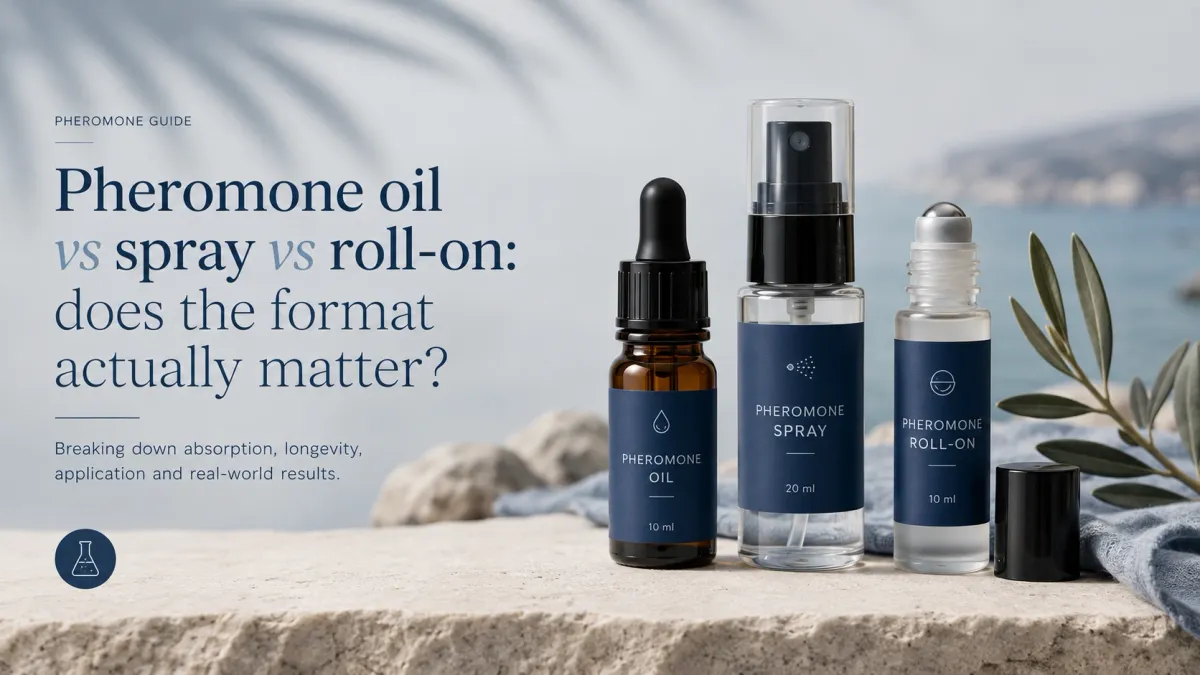
Buy a pheromone oil instead of a spray and the marketing implies you're getting something stronger, longer-lasting, more serious. The catalog data doesn't back that up. Format changes how a product wears and how easy it is to dose, not how well the compounds inside it actually work.
This guide breaks down what each format is genuinely better and worse at, using the scores from every product in the catalog rather than the pitch on the bottle.
Does the format change how well pheromones work?
No. The active compounds and their dose determine the effect, and those can live in any format. A well-dosed spray and a well-dosed oil built on the same compounds will do roughly the same thing to the person standing near you.
What the format changes is everything around the effect: how precisely you can apply it, how close to the skin it sits, how far it throws, how long it lasts, and how easy it is to carry or hide. Those are real differences worth choosing deliberately. They just aren't differences in whether the pheromones do their job.
This matters because "oil-based means more concentrated" is a common upsell, and it doesn't survive contact with the catalog. The top oil (Asian for Asian, 8.7/10) and the top spray (Voodoo for Men, 8.8/10) are separated by a tenth of a point, and both come from the same brand.
What is a pheromone oil actually better at?
A pheromone oil sits close to the skin, wears longer, and projects less, which makes it the quieter, more intimate option. The oil carrier holds the compounds against your skin instead of flashing off the way alcohol does, so the effect stays in a smaller radius for a longer stretch.
That's a feature in close-range settings and a limitation in a crowded room. If the goal is a one-on-one dinner or anywhere the other person is already within arm's reach, a pheromone oil keeps the signal where it's useful without broadcasting it to the whole restaurant. If you want to be noticed across a bar, an oil is working against you.
The catalog has 40 scored oils averaging 6.26/10, almost identical to sprays at 6.12. The format isn't holding oils back or pushing them ahead. The individual formula is what moves the score.
There's a practical trade-off buried in the oil format worth knowing before you buy. Oils take longer to absorb, so they need a minute or two of settle time before you dress or layer anything over them, and a heavy application can leave a faint sheen on skin that a spray never would. For a lot of wearers that's a fair price for the longer wear. For anyone who reaches for a product thirty seconds before walking out the door, it's a genuine annoyance, and the roll-on or spray is the better fit.
What a spray is better at
Projection and variety. Sprays throw the scent and the compounds furthest from your body, and because they're the default format, you get the widest selection to choose from.
That reach is exactly why sprays are the easiest format to over-apply. One extra spray of an androstenone-forward cologne is the difference between commanding and overwhelming, and the alcohol carrier that gives a spray its projection also makes each pump land harder. Sprays reward a light hand. The catalog's 139 sprays are the largest group by far, and they include both the single highest-scoring product (Voodoo for Men, 8.8/10) and plenty of the low-scoring filler, which is what you'd expect from the format everyone defaults to.
If you want the broadest set of options and the most projection, spray is the format to start in. Just treat the trigger with respect: one pump too many is far easier to do with a spray than with any other format, and far harder to walk back once it's on your skin and in the air around you.
What a roll-on is better at
Control and discretion. A roll-on lays down a precise, repeatable amount exactly where you put it, with no drift and no cloud, which makes it the most beginner-friendly way to learn your own dose.
That precision is why roll-ons travel well and suit tight spaces. There's no overspray in an office bathroom, nothing to set off a smoke-sensitive room, and no risk of the wide miss that a spray invites. The catalog only has 8 scored roll-ons, led by S1CK's Truelove at 8.0/10, so the selection is narrow. But for a first pheromone product, the control a roll-on gives you is worth more than a big catalog of ways to over-apply. The roll-on list collects the scored options in one place.
What about droppers, gels, and balms?
These are the specialist formats, each solving a narrower problem than the everyday spray or oil. A dropper is a concentrate, a gel or balm is a skin-close base, and none of them is really meant to be your first purchase.
Droppers are the layering format. The catalog has 62 of them, more than any format except spray, and they exist to be added to a blend or a cover scent rather than worn alone, which is exactly the use the layering guide walks through. The top dropper, Dirty Primitive (8.4/10), is a concentrate you dose into something else.
Gels and balms are the skin-close warm formats, and they're rare: five gels and a single balm in the whole catalog. They tend to suit body-warm compounds like copulins, which is why the one balm is Max-T-150 (8.1/10), a copulins wax. The highest-scoring gel, Nude Alpha Gel (8.6/10), is one of the top-scoring products in the entire catalog regardless of format.
Why do the smaller formats look higher-scoring?
Because of sample size, not superiority, and this is the one number in this guide most likely to mislead you. Gels average 7.98/10 and sprays average 6.12, which looks like a landslide until you count the products behind each figure.
There are five gels and 139 sprays. Those five gels come almost entirely from Liquid Alchemy Labs, the highest-scoring brand in the catalog, so the gel "average" is really just measuring one strong brand's output. The spray average pulls from every brand, including the weakest ones, so it drags toward the middle. Put a weak brand's gel in the catalog and that 7.98 would drop fast.
The honest read: the big buckets (spray 6.12, oil 6.26, dropper 6.43) are close enough to call even, and the small buckets are too small to trust as format verdicts. Don't buy a gel because gels "score higher." Buy a specific gel because that specific product scores higher.
How should you choose between a pheromone oil, spray, or roll-on?
Match the format to how you'll actually wear it, then ignore the format entirely and judge the product on its compounds and score. The order matters: format narrows your options to the ones that fit your life, and then the individual review tells you whether the product inside is any good.
- Close-range, long wear, discreet: a pheromone oil or a roll-on.
- Projection and the widest selection: a spray, applied lightly.
- Precise dosing and travel: a roll-on.
- Layering or DIY blends: a dropper concentrate.
- A warm, skin-close base for compounds like copulins: a gel or balm.
None of these is a ranking. A great spray beats a mediocre oil every time, and the reverse holds just as often. Format only narrows the field down to the products that suit how you live. What decides the actual bottle is the Phero Score.
Bottom line
Format decides how a pheromone product wears, not how well it works. A pheromone oil is the close-range, long-wear, low-projection choice. A spray projects furthest and gives you the most options to pick from. A roll-on hands you the most control, droppers are built for layering, and gels and balms are skin-close specialists.
The score gaps between formats are mostly sample-size noise, not evidence that one format outperforms another. Pick the format that fits how you'll use it, then let compound disclosure and the Phero Score decide the actual product. The men's ranked list and the women's ranked list sort every format by score in one place.