Twenty-three of the 299 products scored on this site list oxytocin as an active compound. Six of the nine brands in the catalog use it. One product, Love Scent's Liquid Trust, sells nothing else: oxytocin is the entire formula and the entire pitch.
The label is honest about the ingredient. What it misrepresents is what that ingredient can do once it is sitting on your neck. This guide walks the whole chain, from the hormone's reputation to the pharmacology to the 23 catalog products that print it anyway.
What is an oxytocin perfume supposed to do?
The pitch is bottled closeness: wear the bonding hormone and people around you trust you faster. Every product in the catalog that lists oxytocin is trading on the same reputation.
That reputation has real biology behind it. Oxytocin is the hormone of labor, lactation, and physical touch, released inside the body at moments of bonding. The press nicknamed it the love hormone years ago and the name stuck.
The commercial version of the story starts in 2005, when a Nature paper reported that men given 24 IU of oxytocin through a nasal spray handed more money to strangers in a trust game. Investors on the hormone transferred more than investors on placebo. One study, 29 people in the treatment group, and an industry of trust products grew out of it.
Liquid Trust is the purest example. Love Scent sells the quarter-ounce bottle for $19.95 and pitches it as "especially popular among salespeople, because it creates an atmosphere of trustworthiness." No other compound is listed. The oxytocin is the product.
Can oxytocin get from your skin to a receptor?
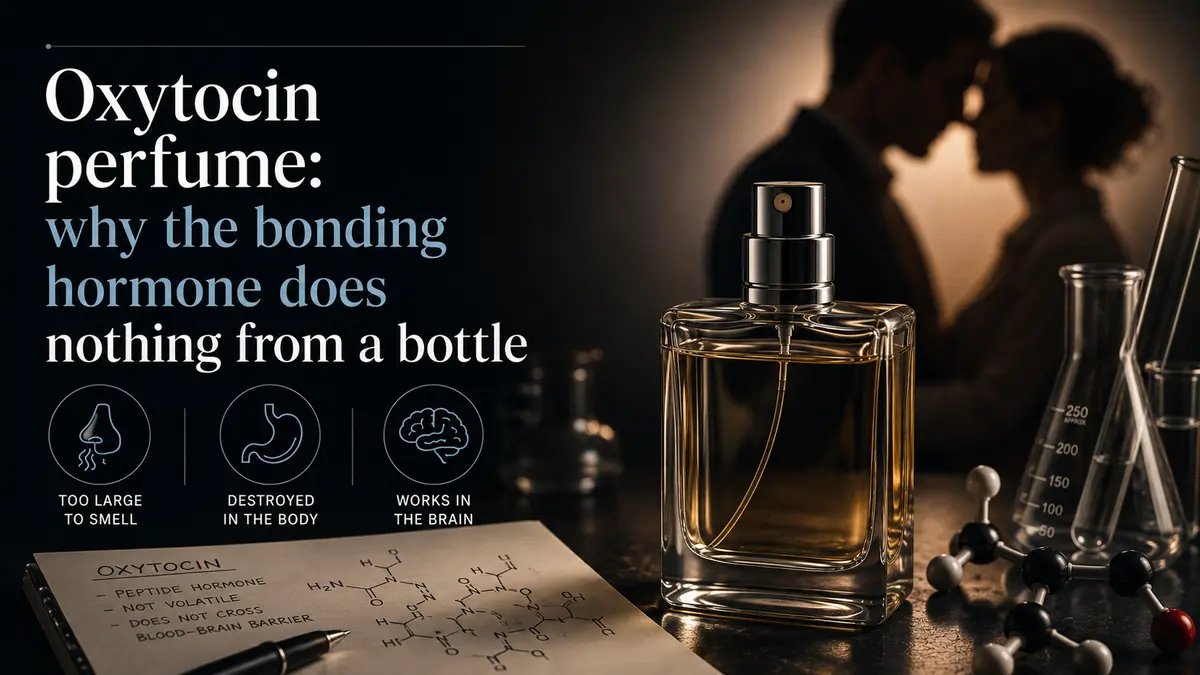
No. It is too large for skin, has no scent to carry it, and survives minutes in blood. Each of those three failures is independent, and any one of them would be enough.
Start with size. Oxytocin is a peptide of nine amino acids weighing about 1,007 daltons. Dermatology's 500 dalton rule holds that molecules much above 500 do not meaningfully penetrate intact skin, which is why the compound appears in the safety rundown on this site as an inert passenger. The pheromone steroids people actually argue about, androstenone and its relatives, sit near 270. Oxytocin is nearly four times heavier.
The airborne route is worse. Androstenone is volatile, which is why a bottle of it smells like something. A peptide does not evaporate. Nothing lifts off your collar and carries oxytocin to another person's nose, and their nose would not be the finish line anyway.
Researchers know all this, which is why studies use a nasal spray aimed at the wearer's own brain. Even there the delivery is dismal. Two Edinburgh neuroendocrinologists who spent their careers on oxytocin estimated that around 0.005 percent of an intranasal dose reaches cerebrospinal fluid, and titled their review "Myths and Delusions." Whatever leaks into blood instead is gone almost immediately: the FDA label for synthetic oxytocin puts its plasma half-life in the range of one to six minutes.
A trace dose in an alcohol spray, applied to skin, evaporating near no one's nostrils, clears every hurdle except all of them.
Did the oxytocin trust research hold up?
No. When the trust game was rerun at ten times the scale, the effect was not there. So even a perfume that somehow delivered the hormone would be built on a result that no longer stands.
The unraveling was gradual, then formal. By 2015, a critical review in Perspectives on Psychological Science had collected six failed attempts to reproduce the original trust finding and concluded the evidence did not support the causal claim. The authors also flagged that most published plasma oxytocin measurements used methods too unreliable to interpret.
Then came the direct test. In 2020, a preregistered replication in Nature Human Behaviour ran 677 participants through the trust game, against the original study's 58 across both arms. It reported no effect of oxytocin on trusting behavior, with 99 percent power to detect an effect the size of the 2005 result.
Line the chain up and every link fails on its own. Skin will not pass the molecule. The nose-to-brain route moves a rounding error. And the behavioral endpoint the marketing describes was never solid to begin with.
Which products sell an oxytocin perfume?
Twenty-three of the 299 scored products list oxytocin, spread across six of the nine catalog brands. The interesting part is how differently they use it.
| Product | Brand | Phero Score | Oxytocin's role |
|---|---|---|---|
| Liquid Trust | Love Scent | 4.5/10 | The only listed compound |
| Oxytocin | Pheromone Treasures | 4.9/10 | Single-molecule listing |
| Pherazone line (16 SKUs) | Pherazone | 5.8 to 7.1 | One of six compounds in every formula |
| PherX oils (3 SKUs) | PherX | 5.9 to 6.6 | One of six listed compounds |
| Pheromone Show | PheroStrong | 6.5/10 | One of six listed compounds |
| NUDE for Gay Men | Liquid Alchemy Labs | 8.3/10 | Rides along four studied pheromones |
Two patterns, and they score very differently.
At the bottom sit the products where oxytocin is the point. Liquid Trust and Pheromone Treasures' bare Oxytocin listing have nothing underneath the claim, and they land at 4.5 and 4.9, the two lowest scores of the 23.
Everywhere else the hormone is a garnish. Pherazone prints the same six-compound stack, oxytocin included, across sixteen SKUs, the same stack PherX and PheroStrong use. NUDE for Gay Men scores 8.3 because of its androstenone, androstenol, androsterone, and estratetraenol, and it would score 8.3 without the fifth name on the list.
How to read an oxytocin listing
Treat it as information about the brand rather than the bottle. The molecule is harmless at these doses. The decision to print it is not neutral.
A brand that lists an inert peptide as an active has told you its ingredient list is a marketing document. That is the same signal as implausible concentration claims and fake-discount pricing, and it often travels with them: Pherazone manages all three at once, which is one reason the brand ranking treats its mid-7 scores as a ceiling.
The Phero Score handles it the same way. Formula credibility rewards named compounds with research or community evidence behind them, and a listing that cannot act gets no credit for being listed. One rubric for every product, applied the same way.
What the listing does not do is contaminate everything around it. A formula built on studied compounds does not stop working because someone in marketing added a trending hormone to the label. Judge the stack that remains when you cross oxytocin off.
Where that leaves Liquid Trust
Liquid Trust is the honest test case, because it removes every confound. No cover scent, no steroid stack, no layering advice. One peptide, a quarter ounce, $19.95.
The full review scores it 4.5/10, near the floor of the catalog. Its transparency is fine, since the compound is named plainly. The score is low because the named compound has no route to a receptor and no replicated effect waiting even if it did.
The frustrating part is that oxytocin genuinely does what the nickname says, inside your body, released by touch, familiarity, and time. A bottle cannot shortcut that loop. If you want a sprayable compound with actual field evidence behind it, the honest overview covers which ones have earned that description, and none of them is a hormone with a molecular weight in four digits.