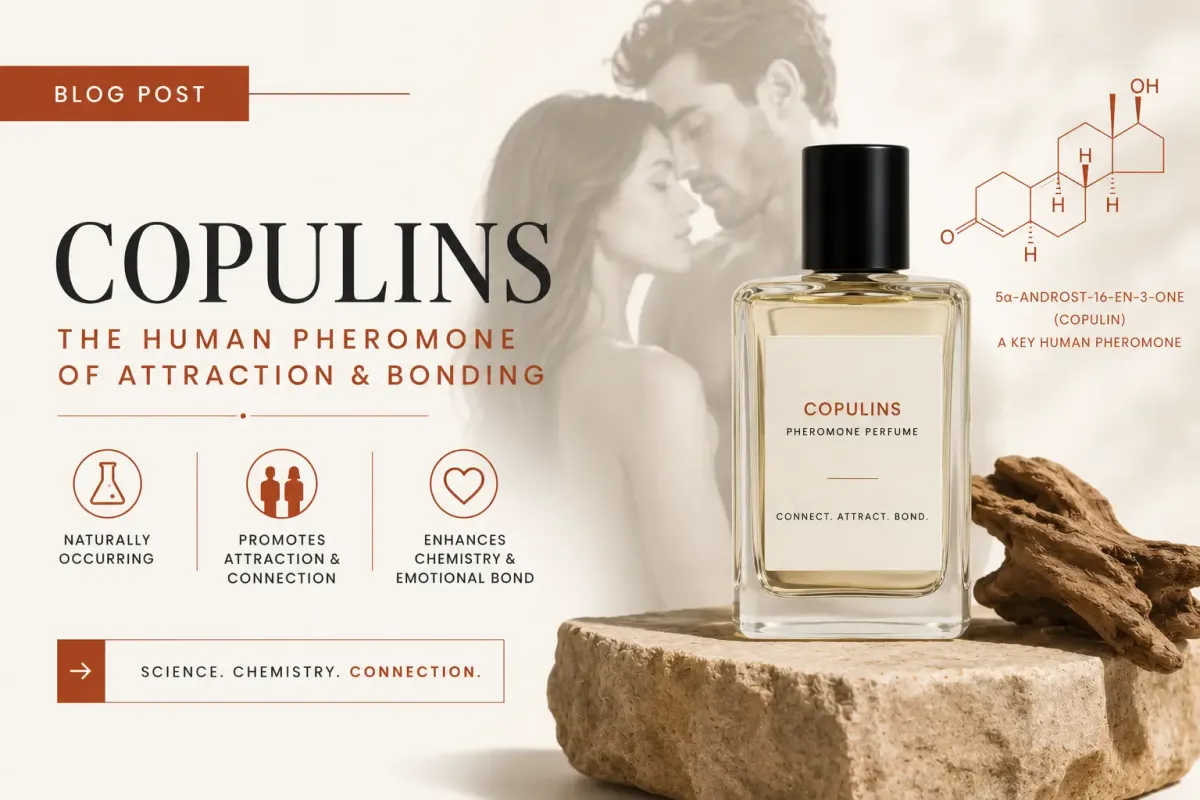
This guide walks through what copulins are, what those three studies actually found (they contradict each other more than most marketing admits), and which products in the catalog are built around the compound.
What are copulins?
Copulins aren't a single molecule. They're a group of short-chain fatty acids (acetic, propanoic, butanoic, isovaleric acid, among others) secreted in vaginal fluid, first characterized in a 1975 paper by Michael, Bonsall, and Kutner using gas chromatography on samples from 50 women. Every woman in that sample produced acetic acid. Only about a third produced the full mix.
The research trail actually starts earlier, and not in humans. Richard Michael, the same researcher, had spent the years before 1975 studying rhesus monkeys, where vaginal fatty acid secretions were shown to trigger mounting behavior in males regardless of visible cues. The human work asked a narrower question: do people respond to a chemically similar mixture the way monkeys do. The answer, as the next section shows, turned out to depend entirely on which study you ask.
Concentration tracks the menstrual cycle in women not using hormonal contraceptives: it climbs through the follicular phase and falls after ovulation. The same 1975 research found that hormonal birth control flattens that fluctuation out almost entirely, which is one reason later studies control carefully for pill use.
In the pheromone community, copulins are treated as the most animal compound in regular circulation. Androstenone gets called dominant. Copulins get called primal, and the community takes that word seriously enough to warn newcomers about dosing it in public.
What does the research actually say about copulins?
It depends which study you read, because the three that matter reached three different conclusions.
The original finding, from Jütte and Grammer in 1997, is the one still cited in marketing copy: exposure to copulins raised men's testosterone and made them worse at discriminating which women's faces were attractive. That's the source of the "150% testosterone" figure that circulates in vendor descriptions and forum posts.
Almost twenty years later, Williams and Jacobson ran a randomized, placebo-controlled attempt to replicate exactly that finding, published in Evolutionary Psychology in 2016. They didn't get the same result. Men exposed to copulins rated women's faces as more attractive on average, the opposite direction from the original impaired-discrimination claim, and rated themselves as more sexually desirable to women. Mate-guarding behavior showed no significant change either way.
Then in 2017, a much larger study pushed further. Researchers ran a placebo-controlled trial on 243 men, testing copulin exposure through both smell and skin contact, and measuring five separate outcomes: sexual motivation, willingness to take sexual risks, preference for short-term mating, perceived female attractiveness, and self-reported mate value. Across all five, exposure to synthetic copulin changed nothing.
So you have an impairment effect, an attraction effect, and a null result, from three studies that each thought they were testing the same thing. That's not a compound with settled science behind it. Treat any flat claim about what copulins do to a man's brain as marketing outrunning the data.
Why does the community call it "copulin fog"?
Because at higher concentrations, some wearers and their partners describe men going quiet, compliant, and a little glassy rather than sharply charged up. Old forum threads use the term "copulin fog" for exactly that state: reduced inhibition without the alertness androstenone tends to produce.
It's a subjective, self-reported effect, not something the controlled studies above measured directly. Worth knowing before you dose heavy for a first try, since the same forums that coined the term also warn that fog isn't always the desired outcome in a public or professional setting.
Dose and setting decide more than the compound does
A light application in a private, one-on-one setting is where most community reports describe copulins working the way people hope. That's also where an overdose is easiest to walk back if it lands wrong.
Wearing a heavy dose in a group or a work environment is a different bet entirely. The "fog" effect, if it shows up at all, isn't something you can dial down mid-conversation, and a handful of forum accounts describe it reading as odd rather than magnetic once more than one person is in the room. Start low regardless of the setting, and the how to apply pheromones guide covers the general dosing mechanics if this is your first pheromone compound.
Why does the smell divide people so sharply?
Because raw copulins smell distinctly organic, and some people find that honest rather than appealing. The scent is often described as sharp, acidic, or overtly sexual, closer to a bodily odor than a perfume note, which is exactly why almost no product sells it unmasked.
Synthetic versions try to approximate the natural compound mix without being identical to it, and vendor descriptions usually flag "synthetic copulins" explicitly for that reason. Most products pair the compound with a cover fragrance heavy enough to soften it. A few, like the wax balm format, lean into a warmer, skin-like base instead of fighting the scent outright.
Which products actually contain copulins?
Five, and they cluster at the higher end of the catalog's price and quality range rather than the bottom. All five come from Liquid Alchemy Labs or Love Scent, and the scores split clearly by brand.
| Product | Format | Gender | Score |
|---|---|---|---|
| Max-T-150 Copulins Wax Balm | Balm | Men | 8.1/10 |
| Pure Copulins 2mg/10ml Pheromone Concentrate | Dropper | Women | 7.3/10 |
| Maui Kiss Copulins Perfume | Spray | Women | 7.3/10 |
| Maui Kiss Copulins Solid Perfume | Oil | Unisex | 7.1/10 |
| Love Scent Copulin Concentrate | Oil | Women | 5.6/10 |
None of the five state an exact milligram dose in the ingredient panel itself, which just lists a generic "proprietary pheromone blend" behind the fragrance line. Pure Copulins is the closer call: the product name states 2mg per 10ml bottle outright, even though that number doesn't repeat inside the formal ingredient list. Treat a name-level dose claim as better than nothing, but confirm it against the label before assuming it's audited the way a supplement panel would be.
One catalog quirk is worth flagging directly. Max-T-150, the highest-scoring copulin product, is tagged for men in the catalog, even though the compound's usual community framing is a formula women wear to affect the men around them. Gender tags describe the labeled target market, nothing more. Read the product page itself rather than assuming from the tag alone.
How should you use copulins without overdoing it?
Start with a single small application and give it a full evening before judging the result. Because the compound's effect (whichever of the three studies above turns out to describe your actual experience) is dose-dependent and slow to read in real time, a first try shouldn't be the night you're testing it in a crowded room.
Pair it with a cover scent unless you specifically want the raw, unmasked smell, since most wearers find the acidic edge easier to manage blended into a perfume base than worn alone. If you're building a full routine around it rather than a one-off test, the best perfume to attract a man guide covers how copulins sit alongside other women's formulas in the catalog.
Bottom line
Copulins have more contradictory research behind them than almost any other compound in this category. The 1997 study found impaired judgment. Its 2016 replication found the opposite. The largest test, in 2017, found nothing measurable at all. That spread should shape how much weight you put on any single vendor's claim about what the compound does.
The catalog's five copulin products score well above the site average, led by Max-T-150 at 8.1/10, which says more about formulation quality than about the compound's proven effect on anyone smelling it. Start with a small dose, expect a subjective and person-dependent result, and treat "copulin fog" as a real community-reported phenomenon rather than a guaranteed outcome. For the full scored list of women's formulas, including the copulin options, the women's ranked list is where to compare them.