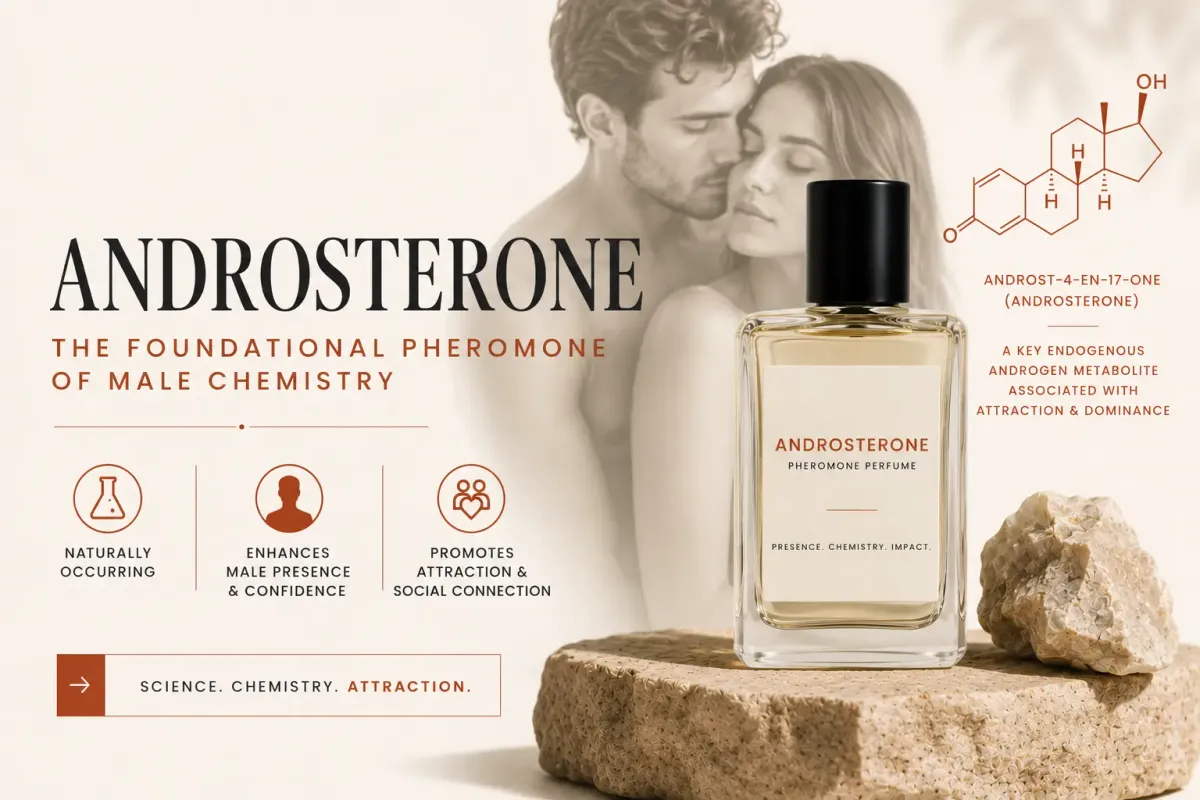
Androsterone is the compound the pheromone community credits with making a wearer seem trustworthy rather than desirable. It's also the compound with the thinnest direct research behind that claim of any molecule in this series so far.
This guide covers what androsterone actually is, what the (very limited) science says about odor and perceived status, why the community splits it into alpha and beta forms, and which catalog products actually name it.
What is androsterone?
Androsterone is a steroid your body makes by breaking down testosterone, and it turns up in sweat, urine, and blood at low concentrations in both sexes, though more in men. Chemically it's androstan-3α-ol-17-one, a mouthful the community shortens to just "andro" in casual threads.
Its discovery has an oddly vivid origin story. In 1931, chemist Adolf Butenandt isolated and identified it from roughly 15,000 liters of male urine collected at the University of Göttingen, making androsterone the first androgen ever isolated. Butenandt won the Nobel Prize in Chemistry in 1939 for that work and his later research on sex hormones. None of that history proves anything about pheromone marketing, but it's a useful reminder that androsterone has been a known molecule for close to a century, well before anyone started selling it in a dropper bottle.
The body makes it in a specific chain: testosterone converts to dihydrotestosterone through the enzyme 5α-reductase, and a second enzyme step reduces that into androsterone, which then leaves the body through urine and, in smaller amounts, through sweat from the apocrine glands. That's the same general gland network androstenone and androstadienone use to reach the skin, which is part of why the pheromone community treats the "andro-" compounds as a related family rather than isolated one-offs.
The pheromone market sells two forms. Alpha androsterone is the one associated with maturity and grounded stability. Beta androsterone, more often labeled epi-androsterone, is framed as the lighter, more social variant. Neither is described in the community as sexual the way androstenone is; both sit closer to a personality-projection compound than an attraction one.
How is androsterone different from androstenone?
Androstenone reads as dominant and sexually charged. Androsterone, at least in how the community talks about it, reads as calm competence. Same steroid family, same testosterone origin point, very different reported effect once it's on skin.
That distinction matters for buyers who assume all the "andro-" compounds do roughly the same thing. Androstenone is the one people warn you not to overdose. Androsterone shows up in forum threads as the compound you layer underneath something louder, precisely because it's not trying to be the loud part of the blend.
What does the research actually say about androsterone?
Honestly, very little, and that's worth saying plainly instead of padding it out. Androstenone and androstadienone both have a real (if contested) body of controlled studies behind them. Androsterone doesn't have an equivalent research trail testing its effect on social perception.
The nearest thing is a 2025 study out of the University of Victoria, published in Evolution and Human Behaviour, which tested whether body odor linked to circulating testosterone shapes how people judge social status. Researchers collected saliva and worn-shirt samples from 76 men, then had 797 people rate those scent samples for perceived dominance and prestige. Higher salivary testosterone correlated with higher dominance ratings. It had no significant relationship with perceived prestige at all.
That result matters here because "prestige," not dominance, is the closer analog to what androsterone marketing promises: trust, maturity, competence rather than raw social force. The one study that comes close to testing this territory found the opposite pairing, testosterone-linked odor read as dominant, not prestigious. It's not a study of androsterone specifically, and androsterone isn't testosterone, so treat the connection as adjacent context rather than direct evidence either way.
One tangential data point worth knowing: a separate study on androstenone perception found men with higher testosterone levels are more sensitive to that compound's odor. It's a different molecule and a different question, but it's more evidence that this whole steroid family is entangled with an individual's own hormone levels in ways marketing copy rarely mentions.
Why does the community split it into alpha and beta forms?
Because wearers report genuinely different social effects from the two, even though both derive from the same parent steroid. Alpha androsterone gets called "the stabilizer": people reportedly start treating the wearer as someone who has things handled, without the wearer doing anything to visibly earn it.
Beta androsterone, the epi- variant, gets a different nickname entirely: the "swag molecule." Forum reports describe it as smoother and more immediately likable, without the weight or heaviness some wearers associate with the alpha form. Neither report has been tested in a lab. Both are self-reported, repeated often enough across independent threads that the site treats them as a real community signal rather than a single outlier's story.
Setting and blend decide more than solo dosing
Alpha androsterone gets used as a foundation layer in blends more often than as a standalone bottle, because "quiet trustworthiness" isn't something most wearers want turned up to maximum on its own. A blend that pairs it with something more socially active tends to get better field reports than alpha worn alone.
Beta androsterone reads better solo in more casual, high-contact social settings, a party or a group hang rather than a formal meeting, since the charisma effect it's known for depends on frequent, lighter interactions rather than one serious conversation. If you're brand new to dosing any pheromone compound, the how to apply pheromones guide covers the general mechanics before you start experimenting with a specific molecule.
Which products actually contain androsterone?
Four, and the scores tell a fairly clean story: blends beat single molecules, and alpha beats beta head to head.
| Product | Brand | Format | Score |
|---|---|---|---|
| LUCKY 7 ROYAL Androsterone Concentrated Pheromones | Liquid Alchemy Labs | Dropper | 8.1/10 |
| Swoon | Pheromone Treasures | Dropper | 7.8/10 |
| Alpha Androsterone | Pheromone Treasures | Dropper | 6.9/10 |
| Beta Androsterone | Pheromone Treasures | Dropper | 5.9/10 |
LUCKY 7 ROYAL tops the group as a finished blend rather than a raw concentrate, which fits the pattern seen with other compounds in this series: a formulated product built around a molecule tends to outscore the molecule sold alone. Swoon lists Astaxanthin alongside Alpha Androsterone among its "five unique pheromone molecules." Astaxanthin is a carotenoid antioxidant, not a pheromone, which is a small but real disclosure inconsistency worth noticing rather than a dealbreaker on its own.
The two single-molecule concentrates give a direct comparison the marketing rarely offers: alpha at 6.9 outscores beta at 5.9. That gap tracks the community's own framing that beta rewards a blend and a specific social context more than it rewards being worn raw.
How should you use androsterone without wasting it?
Pick the form based on the room, not the marketing copy. Alpha for settings where you want to be read as reliable and unhurried, a first meeting with someone you want to trust you. Beta for settings where quick likability matters more, a party, a group outing, anywhere the goal is warmth rather than gravitas.
Layer light rather than reaching for a heavy dose, since neither variant is described in the community as something that needs to be worn strong to register. A small amount under a cover scent, added to a blend you already like, is the more common approach than wearing either form as a standalone statement piece.
Bottom line
Androsterone has the least direct research behind it of any compound covered in this series, and that's the honest headline, not a footnote. What exists is adjacent: a 2025 study linking testosterone-odor to dominance rather than prestige, and an older finding that androstenone sensitivity tracks a man's own testosterone level. Neither tests androsterone directly.
What the catalog does offer is a clean, real comparison: alpha outperforms beta as a standalone concentrate, and a formulated blend like LUCKY 7 ROYAL outperforms both. Treat the "trust and status" framing as community folklore worth taking seriously, not as something a lab has confirmed. For the full scored lineup, including how androsterone sits next to androstenone and androstadienone in a blend, the men's ranked list is where to compare them.